Solitary Bee Hotel
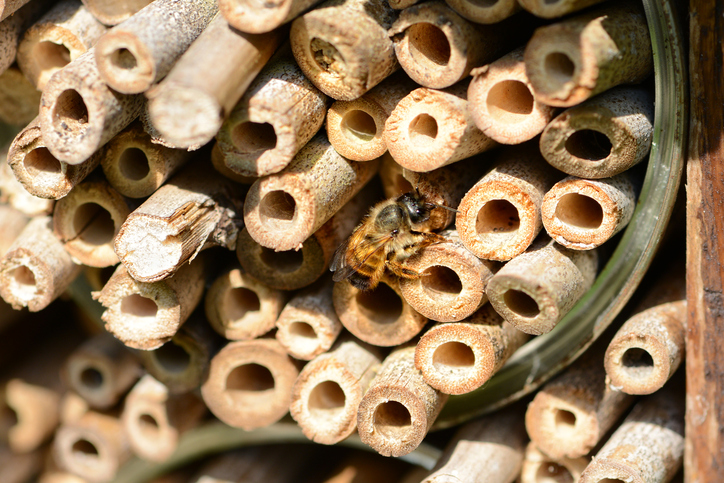
As well as Bumblebees and Honey bees (that live socially) there are over 240 species of wild bees that are called (solitary bees) because they make individual nest cells for their larvae. Most species nest in small tunnels or holes in the ground or in sandy banks, piles of sand, or crumbling mortar or sparse starved lawns.You can leave areas of bare soil or gravel in your garden for these. Others use the hollow stems of dead plants such as brambles, or tunnels previously bored into dead wood by beetles.
A number of species of small solitary wasps share a similar lifestyle. Harmless to us, they are predators of small insects. Some of the more distinctive ones that are common in gardens are described in my fact sheet about solitary bees and gardens.
Although they are known as solitary bees, some species will group their nest cells together in aggregations, and a few have evolved social behavior rather like bumblebees. Many solitary bees are very small and you may not have realized they are bees. All collect nectar and pollen from flowers, except the so-called species that lay their eggs in the nest cells of other species.
Solitary Bees
Think bees and one familiar set of images, habits, and behaviors is likely to come to mind. But this is scratching the surface of all that could be understood about some of nature’s most industrious workers.
Everyone knows the honeybee, but many may be surprised to learn that this iconic insect originally came to the US from Europe, or that it’s just one of about 20,000 species of bees worldwide, with the vast majority of the native species in North America being “solitary bees.” These types of bees, which don’t have a queen or operate as a hive, making them challenging study subjects, are critical to agriculture and the ecosystem as a whole, as most flowering plants on the planet need pollinators to reproduce.
And the honeybee, for all the golden deliciousness it produces, does very poorly compared to solitary bees when it comes to pollinating American native plants such as pumpkins, cherries, blueberries, and cranberries. Solitary bees, on the other hand, pollinate nearly 80 percent of flowering plants and approximately 75 percent of fruits, nuts, and vegetables grown in the country. And possibly the best attribute of solitary bees is that, unlike honeybees, they are non-aggressive. Many don’t even have stingers.